

1.The correlation between impeller rotation and flow velocity: When the measured fluid flows through the turbine flowmeter, the force of the fluid causes the impeller to rotate. According to the principles of fluid mechanics, under certain conditions, the rotational speed of the impeller is directly proportional to the average flow velocity of the fluid in the pipeline. This is because the faster the fluid velocity, the greater the pushing effect on the impeller, resulting in faster rotation of the impeller.
2.Electromagnetic induction generates pulse signals: magnetic propeller blades are installed on the impeller, and electromagnetic induction devices, including permanent magnets and induction coils, are installed on the casing of the flowmeter. When the impeller rotates, the blades periodically cut the magnetic field lines generated by the permanent magnet, causing the magnetic flux in the induction coil to undergo periodic changes. According to the law of electromagnetic induction, changes in magnetic flux will induce pulsating electric potential signals in the coil, known as electrical pulse signals.
3.The relationship between flow rate and pulse signal frequency: Through theoretical analysis and experimental verification, the frequency of the electrical pulse signal is directly proportional to the flow rate of the measured fluid. Therefore, by measuring the frequency of the electrical pulse signal, the flow rate of the measured fluid can be calculated. Usually, in the design and calibration process of turbine flow meters, an accurate proportional coefficient is determined to convert the pulse frequency into the actual flow rate value, thereby achieving precise measurement of fluid flow rate.
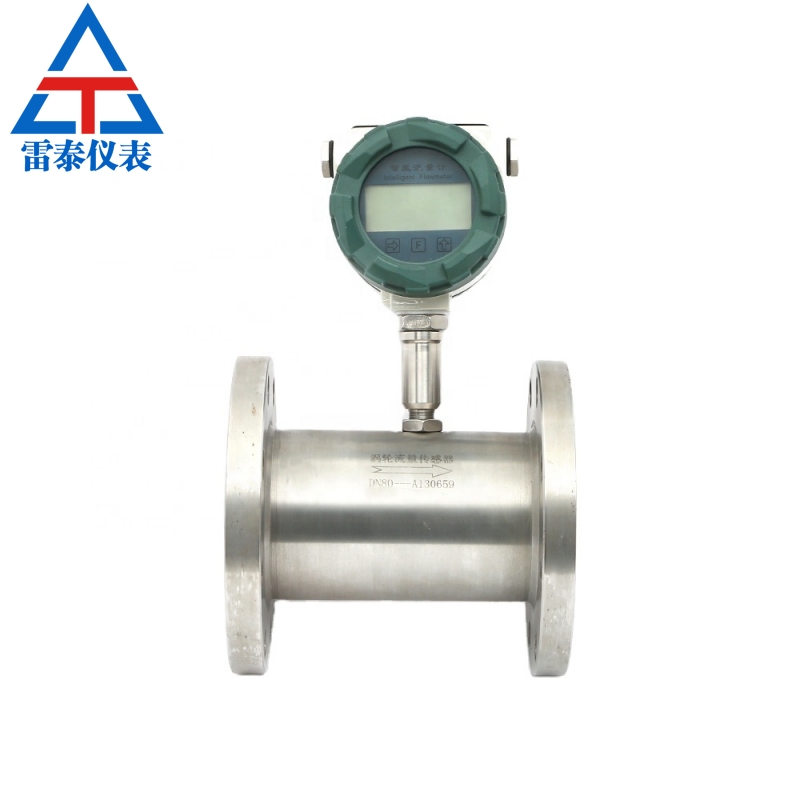
We specialize in producing electromagnetic flowmeter, vortex street flowmeter, turbine flowmeter, thermal gas mass flowmeter, metal tube rotameter, orifice flowlmeter, ultrasonic flowmeter, verabar flowmeter, target type flowmeter, magnetic level indicator, differential pressure transmitter, etc.
