

There are many issues that need to be noted during the installation and use of vortex flowmeters. The following is a detailed introduction:
1. Installation aspect
① Installation location
a. Stay away from interference sources: Avoid strong electrical equipment, high-frequency equipment, strong power switch equipment, etc. to prevent electromagnetic interference from affecting measurement accuracy. At the same time, it is necessary to stay away from high-temperature heat sources and radiation sources to avoid measurement errors caused by temperature effects, as well as to avoid strong vibration and corrosive environments.
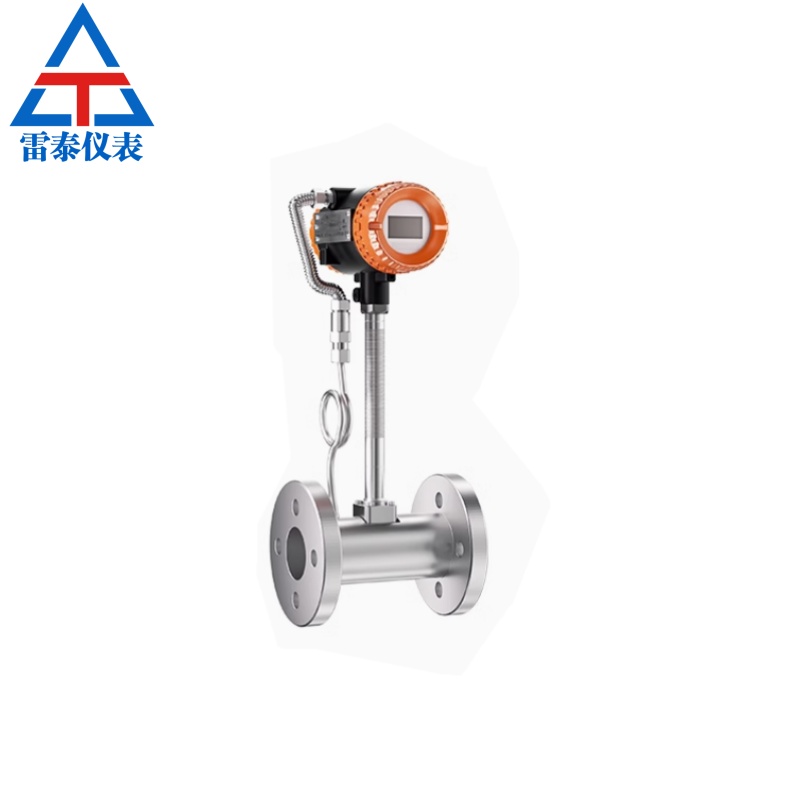
b. Easy to maintain: Choose a location that is easy to install and maintain, with sufficient space around for personnel to carry out debugging, maintenance, and other operations.
② Requirements for straight pipe sections
a. General situation: The length of the upstream straight pipe section is usually required to be no less than 15D (D is the inner diameter of the pipeline), and the length of the downstream straight pipe section is no less than 5D. If there are bends, valves, and other pipe fittings upstream, the length of the straight pipe section should be appropriately increased.
b. Special case: When there are two 90 ° elbows upstream and they are in the same plane, the upstream straight pipe section is ≥ 25D; If two 90 ° elbows are in different planes, the upstream straight pipe section is ≥ 40D.
③ Installation method
a. Concentric and coaxial: The flowmeter and pipeline should be installed in a concentric and coaxial manner, with a coaxial deviation of no more than 0.5DN (DN is the nominal diameter), to ensure that the fluid flows uniformly and stably through the flowmeter and reduce measurement errors.
b. Installation direction: Install according to the arrow direction indicated on the flowmeter housing, ensuring that the fluid flow direction is consistent with the arrow direction. For horizontally installed pipelines, if the measured gas contains a small amount of liquid during gas flow measurement, the flowmeter should be installed at a higher position in the pipeline; When measuring liquid flow rate, if the measured liquid contains a small amount of gas, the flowmeter should be installed at a lower position in the pipeline.
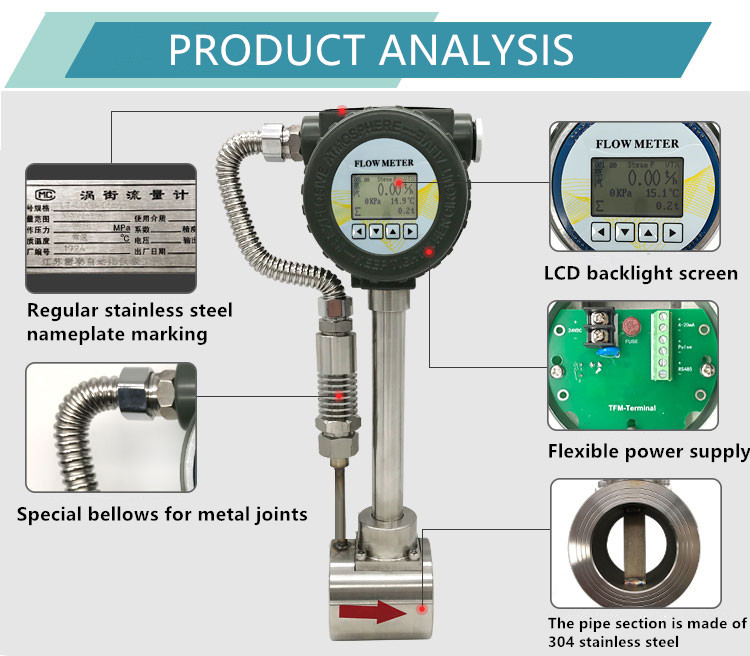
c. Anti vibration measures: If installed on pipelines with strong vibration, vibration reduction measures must be taken, such as setting up pipeline fastening devices at 2D upstream and downstream of the flowmeter, and adding anti vibration pads to prevent vibration from interfering with the measurement.
④ Other precautions
a. Bypass pipeline: In order to facilitate maintenance and repair, it is best to install a bypass pipeline when installing a vortex flowmeter, so that pipeline maintenance and other work can be carried out without disassembling the flowmeter.
b. Sealing: During installation, it is necessary to ensure the sealing of the pipeline connection to prevent fluid leakage, which may affect measurement accuracy, and to avoid safety hazards and environmental pollution caused by leakage.
2. In terms of usage
① Parameter settings
a. Medium parameters: Accurate input of parameters such as density and viscosity of the measured fluid is required before use. These parameters can affect the flow calculation and compensation of the flowmeter, and inaccurate input can lead to measurement errors.
b. Range setting: Reasonably set the range of the flowmeter according to the actual flow range. Setting the range too large or too small will affect the measurement accuracy. Generally, the actual flow should be within the range of 30% -70% of the range.
② Operation and maintenance
a. Regular inspection: Regularly check the working status of the flowmeter, including sensors, signal cables, display instruments, and other components, to check for looseness, damage, corrosion, and other conditions to ensure that all components are working properly.
b. Cleaning and maintenance: Regularly clean the measuring tube and vortex generator of the flowmeter to prevent the accumulation of impurities, dirt, etc., which may affect the measurement accuracy. For fluids containing a lot of impurities, a filter can be installed upstream of the flowmeter.
c. Pressure and temperature monitoring: Pay attention to the pressure and temperature changes of the measured fluid. If it exceeds the working range of the flowmeter, timely measures should be taken to prevent damage to the flowmeter or affect measurement accuracy.
3. Exception handling
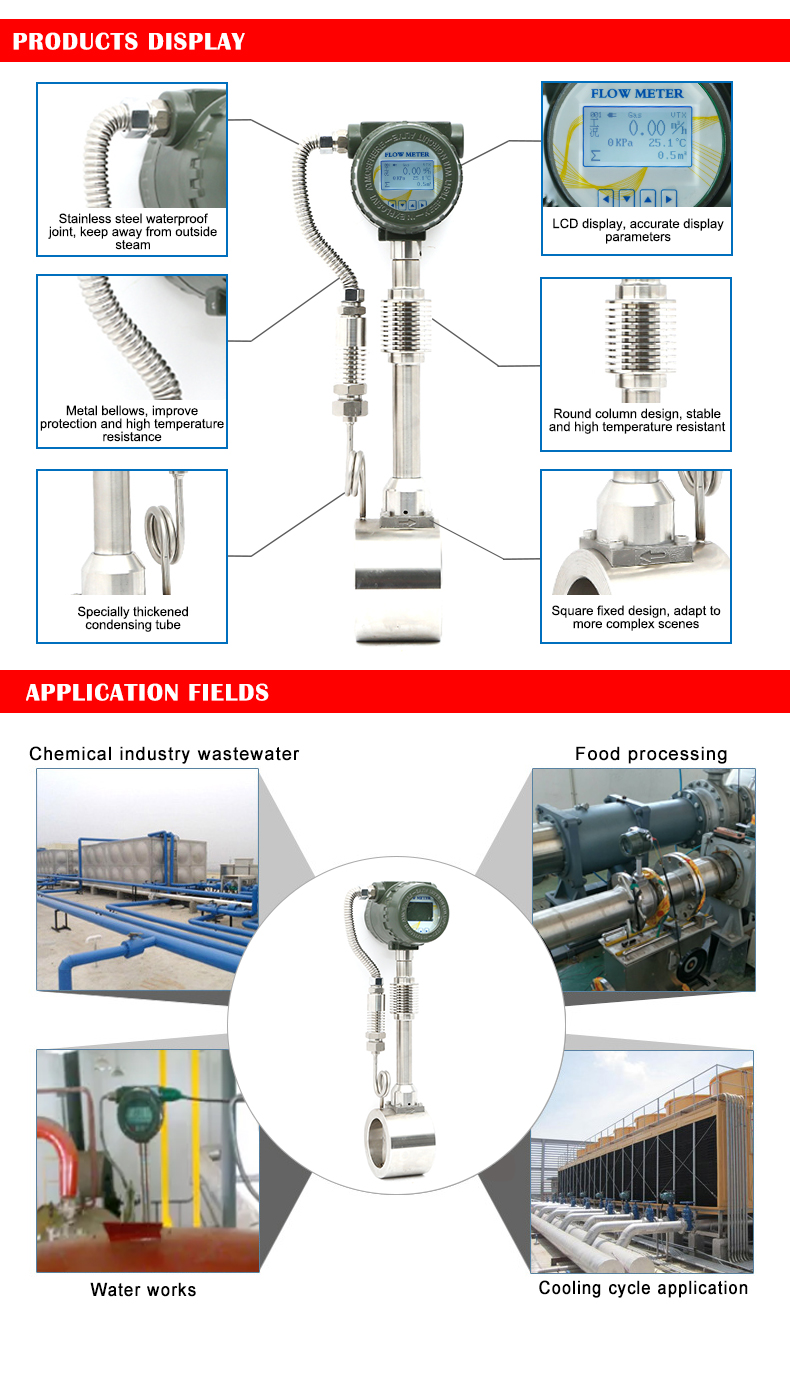
① Signal abnormality: If the output signal of the flowmeter is found to be unstable or abnormal, first check whether the sensor is damaged, whether the signal cable is in good contact, and then check whether the fluid working conditions have changed, such as whether there is gas-liquid two-phase flow, severe flow fluctuations, etc. Specific problems should be investigated and solved.
② Measurement error exceeds the allowable range: When the measurement error exceeds the allowable range, it is necessary to check whether the installation of the flowmeter meets the requirements, whether the parameter settings are correct, and whether the fluid characteristics have changed. If necessary, the flowmeter should be calibrated or reselected.
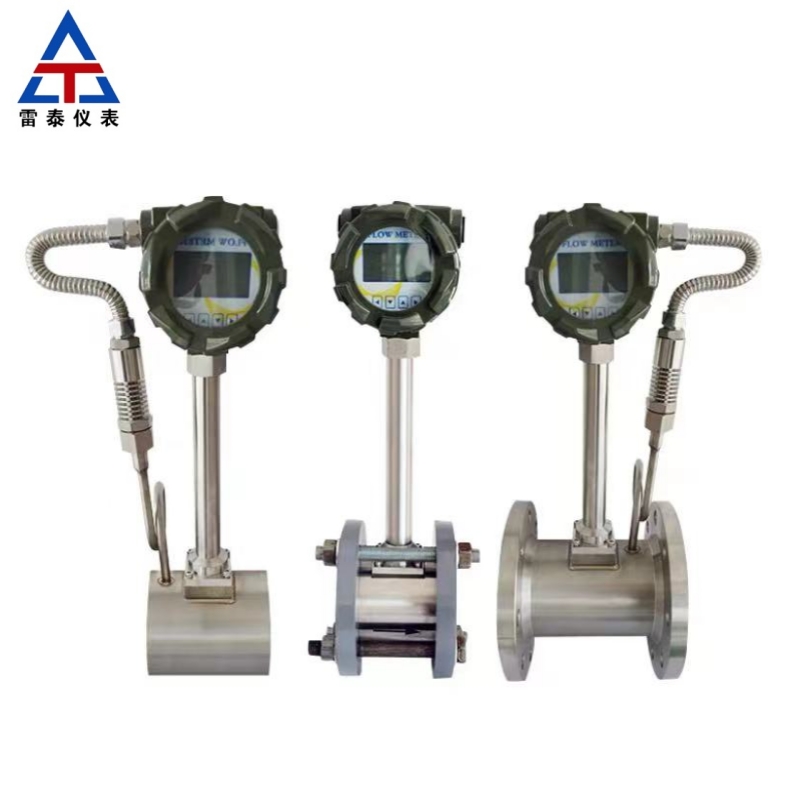
We specialize in producing electromagnetic flowmeter, vortex street flowmeter, spiral vortex flowmeter, turbine flowmeter, liquid gas mass flow meter, metal tube rotameter, orifice flowlmeter, ultrasonic flowmeter, verabar flowmeter, target type flowmeter, magnetic level indicator, differential pressure transmitter, etc.
