

Here are some methods to determine whether an oxygen pressure gauge needs calibration:
1. Check calibration cycle : Refer to the user manual or relevant regulations of the oxygen pressure gauge. The usual calibration cycle is six months to one year. If the time since the last calibration has reached or exceeded the specified period, even if the pressure gauge appears to be working normally, calibration should still be performed to ensure measurement accuracy.
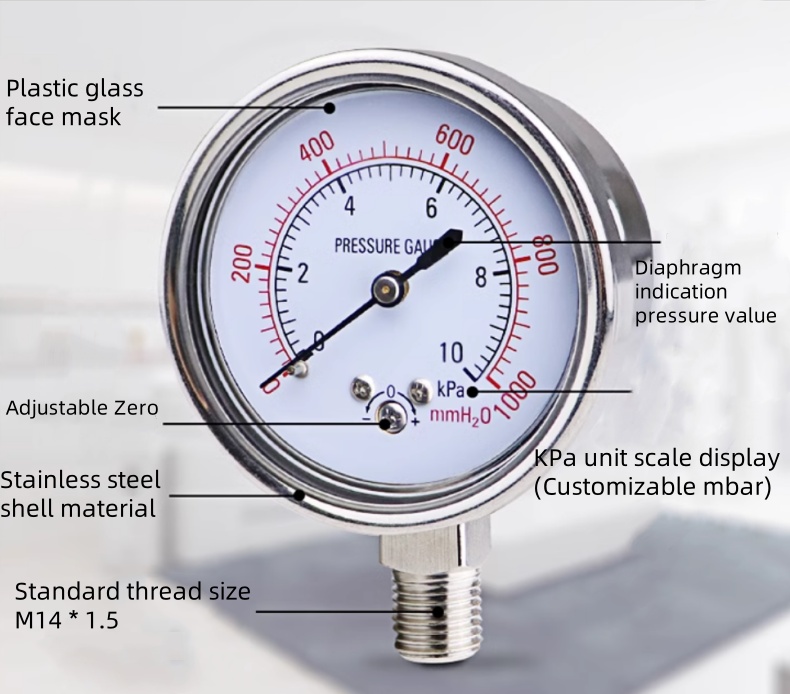
2.Observe the appearance of the pressure gauge: Check for damage, deformation, or corrosion of the case, dial, pointer, and other components. If the dial is stained, the scale is blurry, the pointer is bent, loose, or does not return to zero, it may affect the measurement accuracy and requires calibration.
3.Comparing multiple pressure gauge readings: In the same oxygen system, if there are multiple pressure gauges measuring the same part of the pressure, their readings can be compared. If the reading difference exceeds the allowable error range, the relevant pressure gauge needs to be calibrated.
4.Comparison with standard pressure source: Use a high-precision standard pressure source, such as a piston pressure gauge, to compare and measure with an oxygen pressure gauge. Compare the pressure value output by the standard pressure source with the indicated value of the oxygen pressure gauge. If the error exceeds the accuracy level requirement of the pressure gauge, calibration is required.
5.According to the production process requirements, if the production process requires high accuracy in oxygen pressure, such as in some chemical production processes, even if the pressure gauge reading appears normal, regular calibration should be carried out to ensure the accuracy of process parameters and the stability of product quality. When there is an abnormality in the process and it is suspected to be related to inaccurate oxygen pressure measurement, the pressure gauge should also be calibrated in a timely manner.

6.Judgment after experiencing special circumstances: When the oxygen pressure gauge experiences severe vibration, sudden temperature changes, overload, or other situations that may affect its performance, such as equipment handling, pipeline bursting, etc., even if there is no obvious damage to the appearance, it should be calibrated to confirm whether its measurement accuracy is affected.
We specialize in producing electromagnetic flowmeter, vortex street flowmeter, turbine flowmeter, thermal gas mass flowmeter, metal tube rotameter, orifice flowlmeter, ultrasonic flowmeter, verabar flowmeter, target type flowmeter, magnetic level indicator, differential pressure transmitter, etc.
