

1. Characteristics of the medium
① Medium composition: If the measured medium contains bubbles, suspended solids, or impurities, ultrasonic waves will scatter, reflect, and refract during propagation, resulting in weakened or distorted echo signals and affecting measurement accuracy.
② Medium temperature: Temperature changes can alter the propagation speed of ultrasound in the medium. Generally speaking, as the temperature increases, the speed of sound also increases; The temperature decreases and the speed of sound decreases.
③ Medium pressure: Pressure also has an impact on the propagation speed of ultrasonic waves, especially in high-pressure environments where the density and other characteristics of the medium can change, thereby altering the speed of sound and causing measurement errors.
2. Environmental factors
① Temperature: Changes in ambient temperature not only affect the sound velocity in the medium, but also alter the electronic component performance of ultrasonic level transmitters, resulting in inaccurate measurements.
② Humidity: High humidity environments may cause condensation of water vapor on the surface of ultrasonic transducers, affecting the emission and reception of sound waves. In addition, humid air can also have certain absorption and scattering effects on the propagation of sound waves.
③ Airflow: In an environment with airflow, the propagation direction and speed of ultrasound will be affected by the airflow, causing measurement results to deviate. Especially in windy weather or industrial environments with strong air currents, this impact is more pronounced.
④ Electromagnetic interference: Electromagnetic devices in the surrounding environment, such as motors, transformers, frequency converters, etc., can generate electromagnetic fields that interfere with the electronic circuits and signal transmission of ultrasonic level transmitters, leading to a decrease in measurement accuracy.
3. Installation and Equipment
① Installation position: If installed improperly, such as at the edge of the container or near the mixer, it will interfere with the ultrasonic propagation path, produce false echoes, and affect measurement accuracy.
② Installation angle: The installation angle of the ultrasonic level gauge should be perpendicular to the measured liquid level, otherwise it will cause deviation in the measurement distance and result in inaccurate measurement results.
③ Probe condition: Dirt, wear, corrosion, and other contaminants on the surface of the probe can affect the efficiency of ultrasonic transmission and reception, resulting in weakened or distorted echo signals.
④ Instrument parameter settings: Inaccurate settings for the measurement range, blind zone, sound velocity, and other parameters of the ultrasonic level transmitter can directly affect the measurement results.
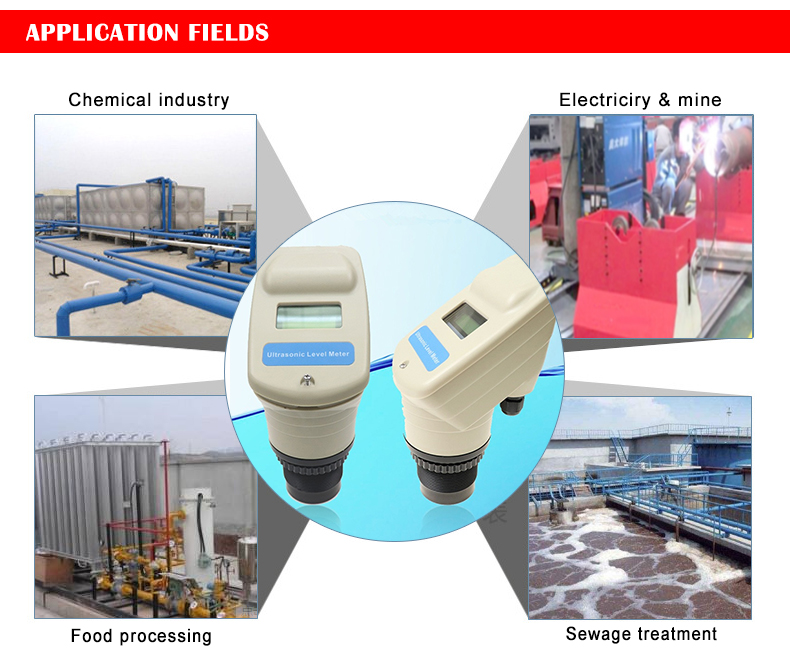
We specialize in producing electromagnetic flowmeter, vortex street flowmeter, turbine flowmeter, thermal gas mass flowmeter, metal tube rotameter, orifice flowlmeter, ultrasonic flowmeter, verabar flowmeter, target type flowmeter, magnetic level indicator, differential pressure transmitter, etc.
