

1. Installation precautions
① Installation location
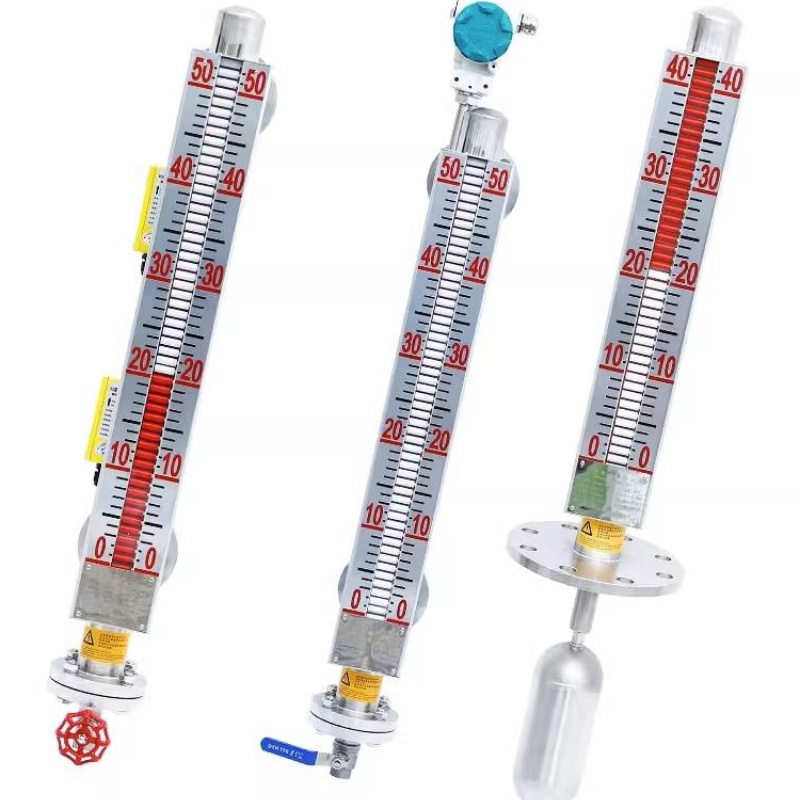
a. The vertical installation position should be selected to ensure that the level gauge is perpendicular to the horizontal plane, with an inclination of no more than ± 5 °, to ensure that the float can move freely up and down in the main tube and accurately reflect changes in the liquid level.
b. Keep away from the liquid inlet and outlet, as well as the agitator, to avoid the impact of liquid flow and the vortex generated by agitation from interfering with the float and affecting measurement accuracy.
② Connection method
a. When using flange connections, it is necessary to ensure that the flange surface is flat and free of deformation, and that the bolt tightening force is uniform to prevent leakage and unstable installation.
b. If a threaded connection is used, attention should be paid to the specification matching and sealing performance of the thread. Sealing tape or sealant can be used appropriately to ensure that there is no leakage at the connection.
③ Distance from other devices
a. A certain distance, generally not less than 200mm, should be maintained between the liquid level gauge and adjacent equipment or obstacles for maintenance and repair operations.
b. For level gauges with remote transmission devices, it is necessary to ensure that the length of the signal transmission line between the remote transmitter and the display instrument meets the requirements, generally not exceeding 100m, to avoid signal attenuation.
④ Float installation
a. When installing the float, pay attention to the direction of the float, ensuring that its heavy end is downward and the light end is upward, so that the float can maintain the correct posture in the liquid and smoothly follow the rise and fall of the liquid level.
b. Be careful during the installation process to avoid collision between the float and the main pipe, prevent damage to the float or affect the performance of its internal magnetic steel.
⑤ Heat tracing and insulation measures
a. If the temperature of the measured medium is too low or too high, the level gauge needs to be heat traced or insulated. The heat tracing medium should be non-magnetic, such as hot water, steam, etc., to avoid affecting the magnetic system of the magnetic flap level gauge.
b. The insulation material should be selected with appropriate material and thickness to ensure good insulation effect. At the same time, attention should be paid to the installation of the insulation layer not affecting the normal observation and maintenance of the liquid level gauge.
2. Maintenance precautions
① Regular inspection
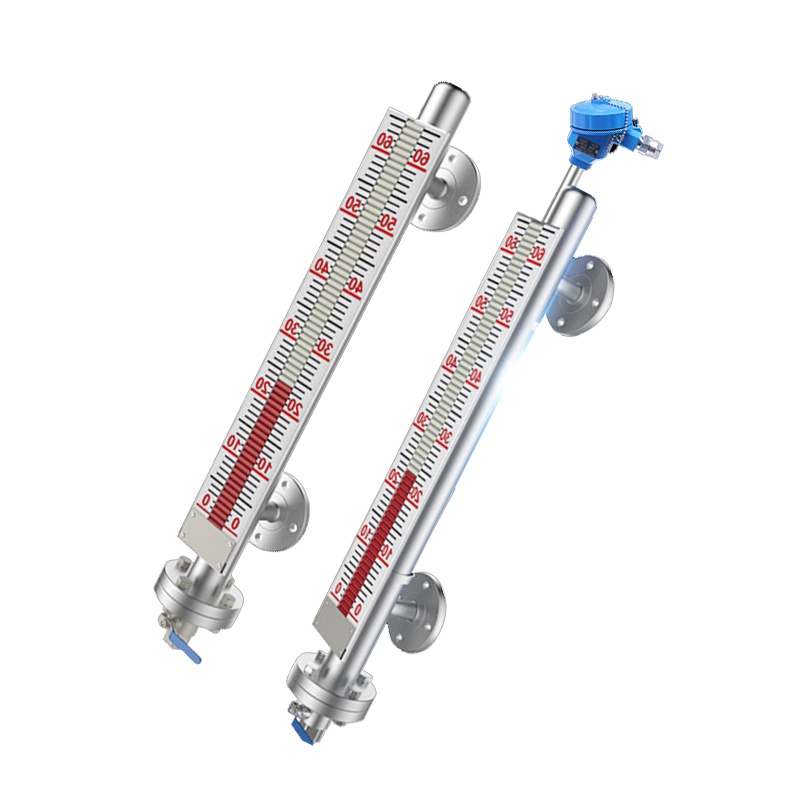
a. Regularly inspect the appearance of the liquid level gauge, check for corrosion, deformation, leakage, and other issues in the main tube, and ensure clear and accurate display on the flip plate. If there are any problems, promptly address them.
b. Check the activity of the float to ensure that it can move freely up and down within the main tube without any obstruction. The float can be manually operated to observe whether it can drive the flipping plate to flip normally.
② Cleaning and maintenance
a. Regularly clean the inner wall of the main tube and the surface of the float of the liquid level gauge to prevent dirt, impurities, etc. from adhering to it, which may affect the buoyancy and magnetic coupling effect of the float. When cleaning, use a soft damp cloth or specialized cleaning agent to avoid scratching with sharp tools.
b. For the flip indicator, its surface should be kept clean to avoid dust and oil stains blocking the line of sight and affecting the observation of the liquid level.
③ Magnetic steel performance inspection
a. Regularly check the magnetic strength of the magnetic steel inside the float and the flipping plate. If the magnetic strength weakens or disappears, the magnetic steel should be replaced in a timely manner to ensure the normal operation of the magnetic coupling.
b. During use, it is necessary to avoid interference from strong magnetic fields on the level gauge and prevent demagnetization of the magnetic steel.
④ Remote transmission device maintenance
a. For level gauges with remote transmitters, it is necessary to regularly check the working status of the transmitter, including whether the power supply is normal and whether the signal output is stable.
b. Check whether the installation of the transmitter and the main pipe is firm, and whether the distance between the sensor and the float is appropriate. If there is any looseness or displacement, it should be adjusted in a timely manner.
⑤ Seal replacement
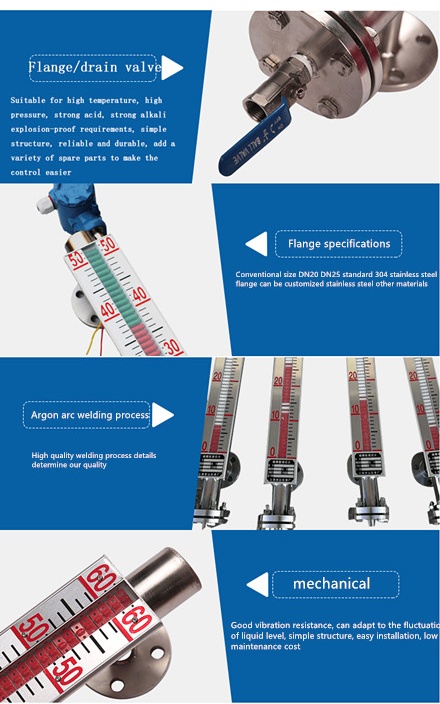
a. Regularly inspect the sealing components of the liquid level gauge, such as sealing rings, gaskets, etc. If aging, damage, or leakage is found, they should be replaced in a timely manner to ensure good sealing of the liquid level gauge.
b. When replacing seals, it is important to choose the appropriate material and specifications to ensure the sealing effect.
We specialize in producing electromagnetic flowmeter, vortex street flowmeter, turbine flowmeter, thermal gas mass flowmeter, metal tube rotameter, orifice flowlmeter, ultrasonic flowmeter, verabar flowmeter, target type flowmeter, magnetic level indicator, differential pressure transmitter, etc.
